Desert Animals in English for Kids
Desert Animals in English for Kids: Words and Activities introduces 15 animal names and short sentence patterns. Children learn familiar words such as camel, snake, and lizard, followed by the fennec fox and jerboa. Pictures, movement, sorting games, and questions strengthen recall. Instead of memorising a long list, a child hears each word, connects it with an animal, says it in a phrase, and uses it in a task.
Essential Desert Animal Words
Start with animals that look different. Visual contrasts connect each English word with a shape, movement, or feature. Introduce four or five words at a time, then combine old and new vocabulary during review.
For Desert Animals in English for Kids: Words and Activities, accuracy matters more than speed. Explain that a camel’s hump stores fat, not water. Separate tortoise from turtle at first: a tortoise lives on land, while turtle often describes animals that spend more time in water.
Useful Phrases and Examples in Context
A noun is the first step. Add a verb or feature to build meaning: a camel walks, a jerboa jumps, and a snake slithers. In Desert Animals in English for Kids: Words and Activities, short patterns turn vocabulary into speaking practice.
- It has… The oryx has long horns.
- It can… The roadrunner can run quickly.
- It lives… The fennec fox lives in the desert.
- It eats… The camel eats desert plants.
- It is… The scorpion is small, but its tail is easy to see.
- It hides… The lizard hides between the rocks.
Reuse the language in questions: “Which animal has a shell?”, “Can a snake walk?”, or “What does the jerboa do?” Accept a beginner’s one-word answer, then model the full sentence. Older learners can compare two animals: “A camel is larger than a fennec fox, but both can live in dry places.”
How to Introduce the Words
Begin with a desert scene, not a written list. Show sand, stones, sparse plants, and several animals. Name one animal, pause, and ask the child to point. Listening reduces pressure and confirms meaning before pronunciation starts.
Next, the child copies the word and adds an action: sway for camel, hop for jerboa, curl an arm like a scorpion’s tail, or move a hand like a snake. Pronounce each word at a natural pace without splitting it into distorted sounds.
Finish with a choice or information gap. Hide one picture and ask, “Is it the lizard or the tortoise?” LearnLink tutors adjust the sequence to each child’s language level. A multilingual child can compare the English name with names used at home, then complete the speaking task in English.
Activities for Different Ages
The animal set supports children from age 4 to 15, but each task should match attention span and language level. Use this comparison to choose a starting point for Desert Animals in English for Kids: Words and Activities.
Age is a guide. An older first-time online learner may need a shorter task, while a confident younger learner may give clues or compare animals. Keep the thinking challenge suitable without making the English instructions needlessly hard.
Practice Games at Home
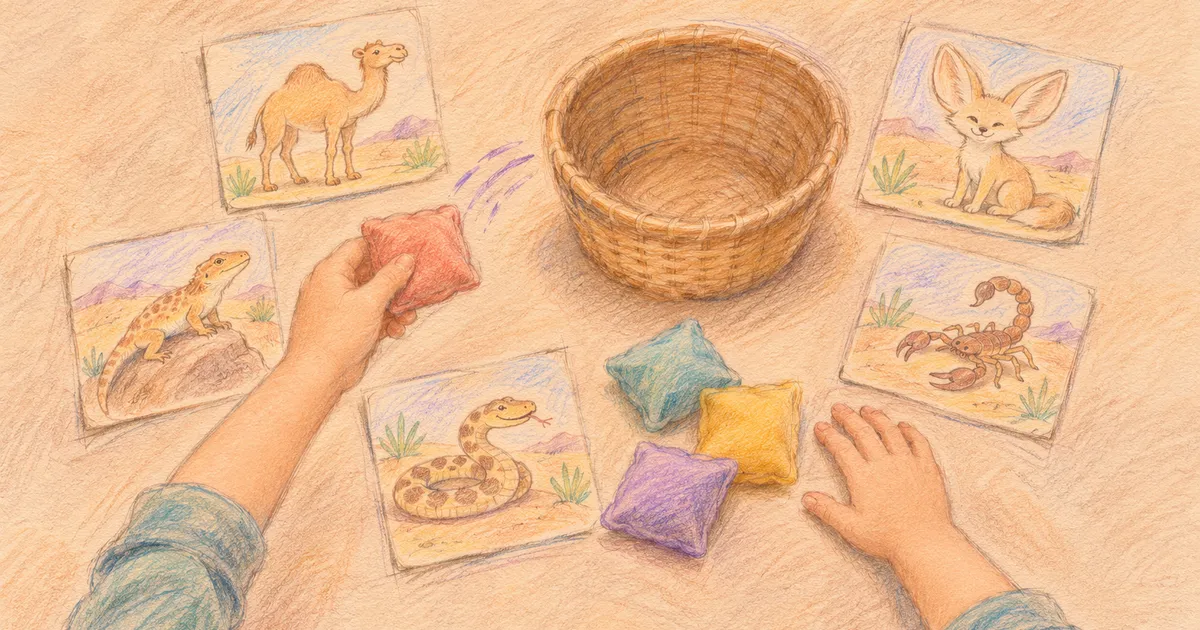
Play five-minute games often instead of covering every word in one long session. Place four pictures on a table and say, “Touch the animal with horns” or “Move the animal that can hop.” Then switch roles and let your child direct the game.
Build a Desert Animal Riddle
Choose one animal without naming it. Give three clues using It is…, It has…, and It can…. For example: “It is small. It has large ears. It can run.” The other player guesses, “Is it a fennec fox?”
Try “desert rescue”: place animal pictures around the room and describe the animal to find. Older children can correct one false clue. The game gives Desert Animals in English for Kids: Words and Activities a purpose for careful listening beyond repetition.
Correcting Common Mistakes
Children may confuse desert and dessert. Use full sentences: “A camel lives in the desert” and “Fruit is our dessert.” For readers, note that dessert has two letters s. Keep the spelling explanation brief while the child learns the animal names.
Pronouns can cause trouble. English usually uses it when an animal’s sex is unknown: “It has long horns.” Use they for more than one: “They hide during the day.” Model corrections in a natural reply instead of interrupting every sentence.
Avoid teaching all desert animals as though they share identical habits. Certain species are active at night; others appear by day. Plant-eaters, hunters, and scavengers need different clues. Match each picture and sentence to the specific animal. Precise meaning strengthens recall.
- Practice naming five desert animals with children aged six to nine today.
- Use picture cards to contrast camel, lizard, snake, and scorpion pronunciations.
- Correct singular and plural forms by sorting one animal versus several animals.
- Ask your child to describe two adaptations using complete English sentences.
- Repeat difficult words three times, then revisit them after tomorrow’s storybook.
When a word has several meanings or pronunciations, Cambridge Dictionary is a useful check before turning it into child-friendly examples.
Frequently Asked Questions
How Many Desert Animal Words Should a Child Learn at Once?
Four or five new words are enough for one short session. Review them through pointing, movement, and questions before adding more. A child who recalls them easily can continue; hesitation signals another game with the same set. Include learned animals in later activities to build lasting recall.
Should My Child Learn Spelling at the Same Time?
Young beginners can learn sound and meaning first. Add writing once your child recognises the animal and says its name. Readers can label pictures, complete missing letters, or group spelling patterns. Spelling should support speech, especially during a child’s first online English lessons.
How Can I Explain What a Desert Is in Simple English?
Say, “A desert is a place that gets little rain.” Show sand, stones, mountains, and plants because deserts are not all seas of sand. Ask what animals need there: water, food, shade, and safe hiding places. The setting then connects directly to the vocabulary without a long science lesson.
Can a Multilingual Child Study These Words Without Translation?
Yes. Pictures, gestures, choices, and short English definitions convey most meanings. Translation can help when two animals look alike or a clue remains unclear. During Desert Animals in English for Kids: Words and Activities, invite links between languages, then return to an English phrase such as “The jerboa can jump” for active practice.
A short one-to-one lesson can show what level and pace fit your child — book a trial English lesson.
Stay updated on our latest tips and resources by following us on Instagram LearnLink.